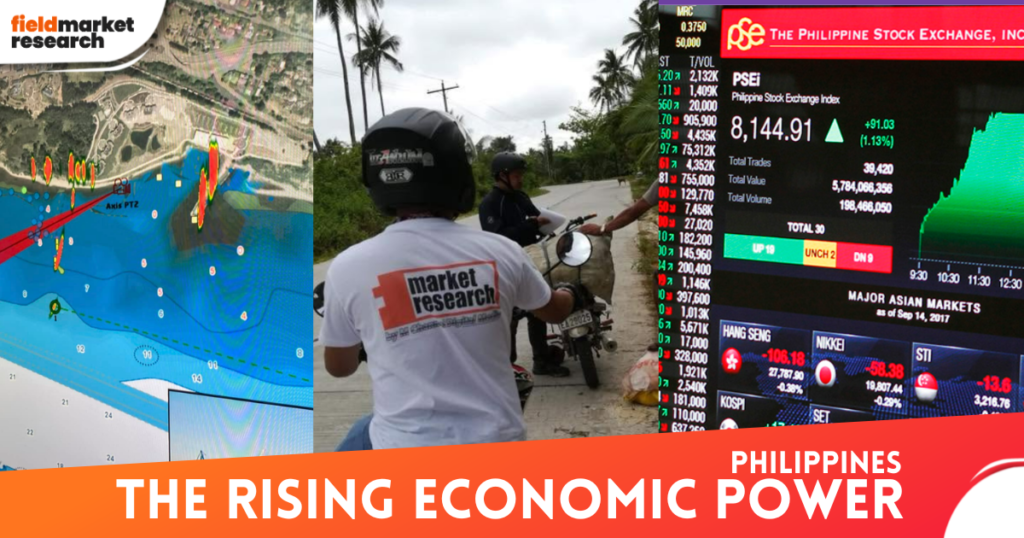
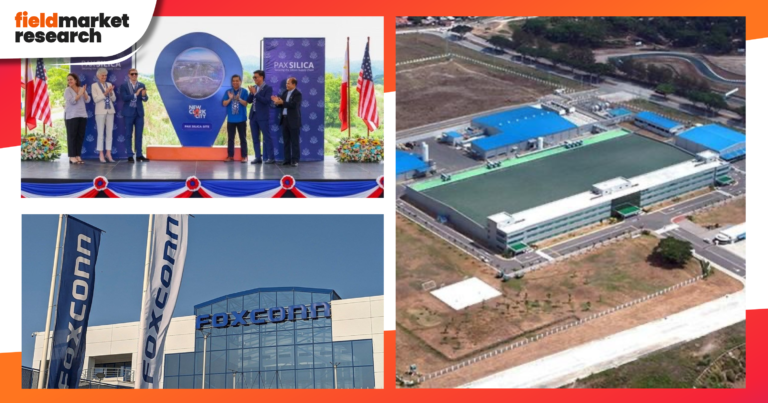
Southeast Asia has become one of the most attractive destinations for global businesses seeking new markets with high growth potential. The region’s expanding economies, youthful populations and rising digital adoption continue to attract multinational corporations, venture capital firms and entrepreneurs seeking long-term opportunities.
Among these emerging markets, the Philippines has become one of the most promising investment destinations.
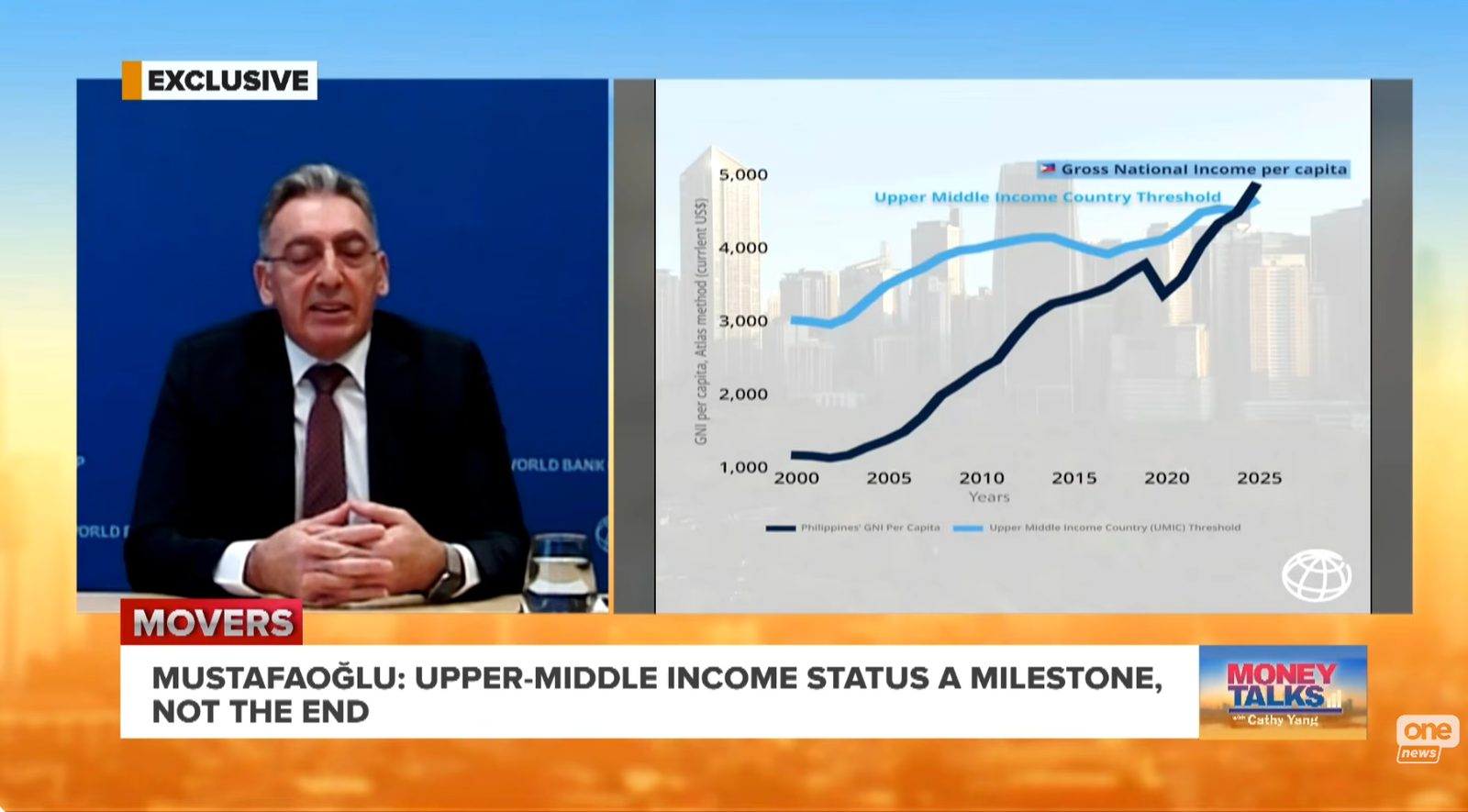
Click the image to watch the World Bank interview on YouTube.
The Philippines has been reclassified as an upper-middle-income country according to the World Bank’s income classification, marking an important milestone in its economic development. This achievement does not remove existing challenges, but it reflects decades of steady progress in economic growth, job creation, infrastructure development and private-sector expansion.
With a population of more than 113 million, a highly skilled English-speaking workforce and a strategic location within the Association of Southeast Asian Nations (ASEAN), the country remains attractive to investors seeking long-term opportunities in one of Asia’s fastest-growing regions.
Why the Philippines Matters to Investors
- Upper-middle-income status: The classification signals rising national income and a more mature economic environment.
- Large domestic market: More than 113 million consumers provide substantial long-term demand.
- Young and skilled workforce: Filipino professionals are recognized for English proficiency, adaptability and technical ability.
- Strategic ASEAN position: The Philippines can serve as a gateway to regional trade and a market of more than 680 million consumers.
- Expanding industries: Technology, finance, healthcare, logistics, manufacturing and digital services continue to grow.
| Key Topic |
Explanation |
Why It Matters to Investors |
| Upper-Middle-Income Status |
The World Bank classification recognizes sustained growth in Gross National Income per capita. |
It strengthens international confidence and signals a more developed investment environment. |
| Economic Milestone |
The reclassification reflects decades of progress in national income, business activity and economic performance. |
Long-term progress is generally associated with resilience and future growth potential. |
| Infrastructure Development |
Investment continues in transport, telecommunications, airports, seaports, roads and digital connectivity. |
Better infrastructure can reduce operating costs and improve supply chains. |
| Private-Sector Expansion |
Private companies are increasingly driving innovation, employment and entrepreneurship. |
A stronger private sector creates opportunities for partnerships, capital investment and expansion. |
The Philippines’ Economic Shift
The country’s move to upper-middle-income status is more than a simple change in classification. It is the product of years of economic reforms, increased productivity, expanding industries and stronger investor confidence. The milestone points to steady improvement in national income and a stronger foundation for future development.
Economic growth has been supported by domestic consumption, overseas remittances, business process outsourcing, infrastructure investment, manufacturing, tourism and the digital economy. These sectors have created jobs and opened new income opportunities for Filipino households.
The milestone is not the final destination. Continued progress will depend on improvements in education, healthcare, infrastructure, governance, productivity and regional inclusion.
Why Global Investors Are Paying Attention
The Philippines offers a rare combination of market size, economic resilience and growth potential. Its large population and youthful demographic profile support sustained consumer demand across retail, finance, healthcare, education, technology and digital services.
The country’s location within ASEAN also gives businesses access to regional supply chains and trade opportunities. Government investment incentives, economic zones, tax reforms and selected liberalized foreign-ownership rules have made the market increasingly accessible to international companies.
The Philippines’ Best Competitive Advantage: Its People
Infrastructure and government policy are important, but the country’s greatest competitive advantage remains its people. Filipino professionals are internationally recognized for strong English communication, adaptability, professionalism and service excellence.
These qualities have helped make the Philippines a global leader in business process outsourcing, shared services, finance, healthcare support, software development, engineering and digital operations. Hundreds of thousands of graduates enter the workforce each year in business, information technology, healthcare, engineering, education and communications.
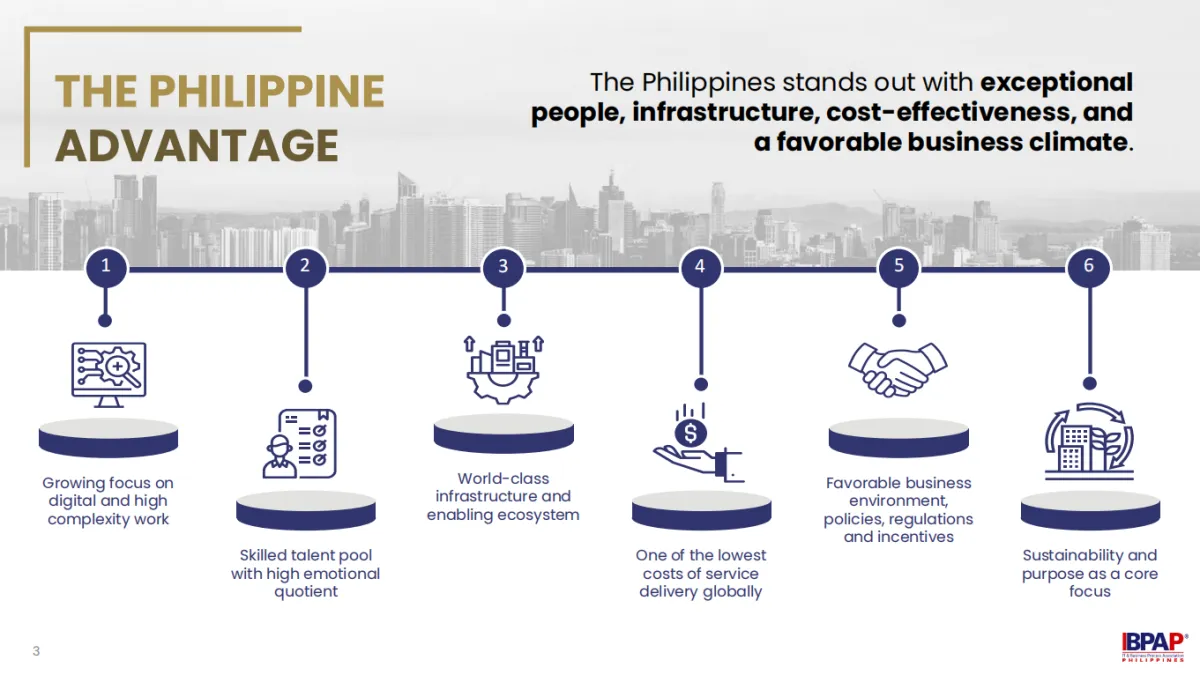
The Philippine Advantage. Source referenced in the original document: KMC Solutions.
| Indicator |
Philippines |
| Population | 113+ million |
| Median Age | Approximately 26 years |
| English Proficiency | High |
| Internet Users | 90+ million |
| BPO Workforce | Approximately 1.8 million |
| Higher Education Graduates | Hundreds of thousands annually |
Illustrative Competitive Strengths
The following ratings are illustrative summaries for visualization and are not official statistical measurements.
| Workforce Capability |
Illustrative Strength |
| English Skills | ★★★★★ |
| Service-Related Skills | ★★★★★ |
| Technological Skills | ★★★★☆ |
| Domestic Consumption | ★★★★★ |
Investment Drivers and Growing Industries
Economic modernization and digital transformation are creating opportunities across multiple industries. Automation, cloud platforms and AI-powered business solutions are strengthening information technology, cybersecurity and digital innovation.
Business Process Outsourcing and AI-Enabled Services
The Philippines remains a global leader in customer support and shared services. The industry is now moving into higher-value areas such as knowledge process outsourcing, finance, healthcare information management, engineering, analytics and AI-enabled operations.
FinTech and Digital Banking
Financial inclusion, mobile payments and digital banking adoption are generating opportunities for technology providers, banks, payment platforms and businesses serving individuals and small enterprises.
Healthcare, Renewable Energy and Infrastructure
Rising domestic demand and government development programs are supporting investment in healthcare, renewable energy, logistics, transport infrastructure, manufacturing, agribusiness and cloud computing.
market research and Data Analytics
Companies entering the Philippines need reliable information about consumers, competitors and regional differences. Market research helps reduce risk, evaluate demand and guide smarter investment decisions.
Challenges Every Investor Needs to Understand
Like other emerging economies, the Philippines presents operational and structural challenges. Business registration and regulatory compliance may take longer than in some neighboring countries. Energy costs remain relatively high, infrastructure still requires further development, and climate risks must be considered in long-term planning.
- Conduct thorough market and feasibility research before entering the market.
- Build strong relationships with experienced local partners.
- Include climate, logistics, energy and regulatory risks in financial planning.
- Choose locations based on workforce availability, infrastructure and customer access.
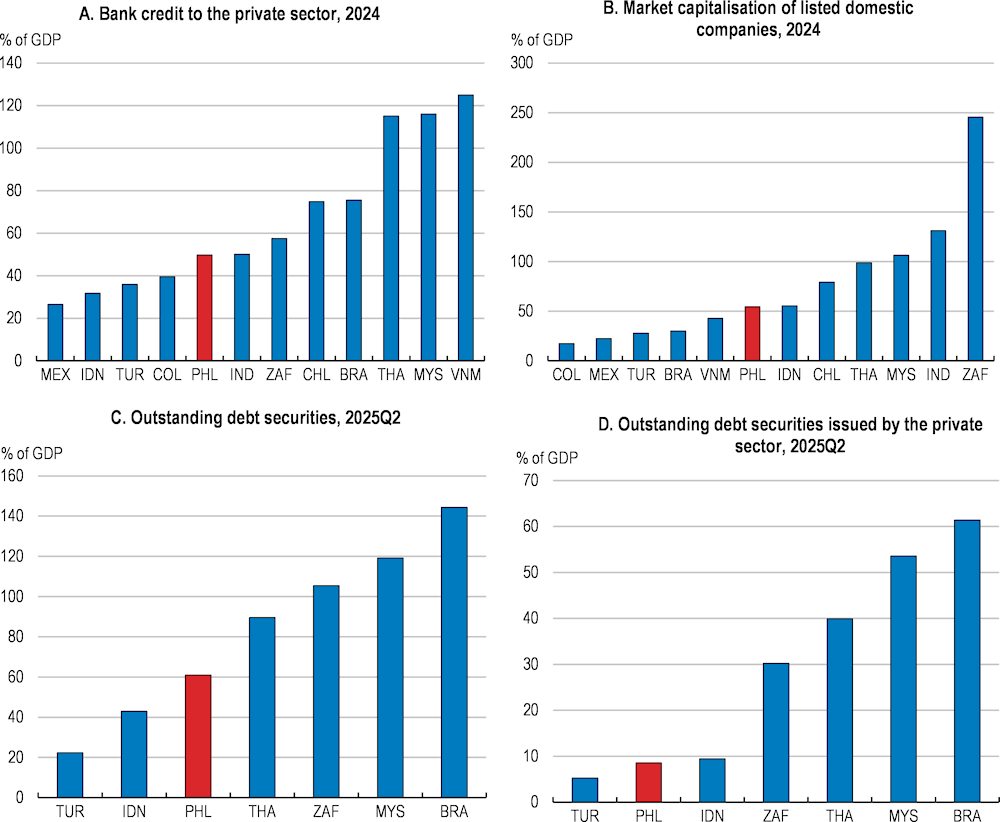
Philippine financial-market comparison. Source referenced in the original document: OECD.
The financial-market graphs show that the Philippines has a moderately developed financial sector. It performs reasonably well in bank lending and the overall bond market, although its private corporate bond market remains relatively small. This creates room for deeper capital markets and additional financing options for businesses.
Lessons from Successful Economies
South Korea demonstrates how investments in education, innovation, technology and exports can build globally competitive industries. Singapore shows the value of governance, infrastructure and business efficiency, while Vietnam highlights the benefits of industrial development and export-oriented growth. Poland illustrates how structural reform and international integration can accelerate development.
The Philippines can build on these lessons by strengthening productivity, improving infrastructure, expanding digital connectivity and maintaining a competitive environment for domestic and foreign investors.
What’s Next for Investing in the Philippines?
The country is well positioned to benefit from artificial intelligence, digital infrastructure, financial technology, renewable energy, startup development and greater ASEAN integration. Foreign investors increasingly recognize that the Philippines offers more than cost-efficient labor: it provides a capable workforce, rising domestic demand, improving connectivity and a large regional opportunity.
| Investment Driver |
Current Strength |
Future Outlook |
| Skilled Workforce | ★★★★★ | Very strong |
| Domestic Consumption | ★★★★★ | Expected to grow |
| Digital Infrastructure | ★★★★☆ | Rapid expansion |
| Artificial Intelligence | ★★★★☆ | High growth |
| FinTech | ★★★★☆ | High growth |
| Renewable Energy | ★★★★☆ | Strong growth |
| ASEAN Trade | ★★★★★ | Increasing integration |
Investing in the Philippines means participating in one of Southeast Asia’s most dynamic and rapidly developing economies. Its upper-middle-income classification reflects years of progress and growing international confidence. A young and talented workforce, expanding consumer market, improving infrastructure and continuing reforms have made the country a highly competitive investment destination.
Challenges remain, but so do substantial opportunities. Businesses that take a long-term perspective, develop local partnerships and understand the Philippine market are well positioned to benefit from the country’s continued economic transformation.