How to Write a Qualitative Interview Questionnaire: Prevent Costly Mistakes in Field Market Research
One of the most underrated aspects of market research is creating a questionnaire for a qualitative interview. Many novice researchers feel that developing interview questions is easy: just ask what you want to know and write down the replies. Developing a good qualitative interview guide is complicated in practice, requiring careful planning, testing and refining. […]
By Bryan Cinco
One of the most underrated aspects of market research is creating a questionnaire for a qualitative interview. Many novice researchers feel that developing interview questions is easy: just ask what you want to know and write down the replies. Developing a good qualitative interview guide is complicated in practice, requiring careful planning, testing and refining.
No matter if you are doing a Computer-Assisted Telephone Interview (CATI), Computer-Assisted Personal Interview (CAPI), Focus Group Discussion (FGD), Key Informant Interview (KII) or In-Depth Interview (IDI), the quality of your data will depend greatly on the quality of your questionnaire.
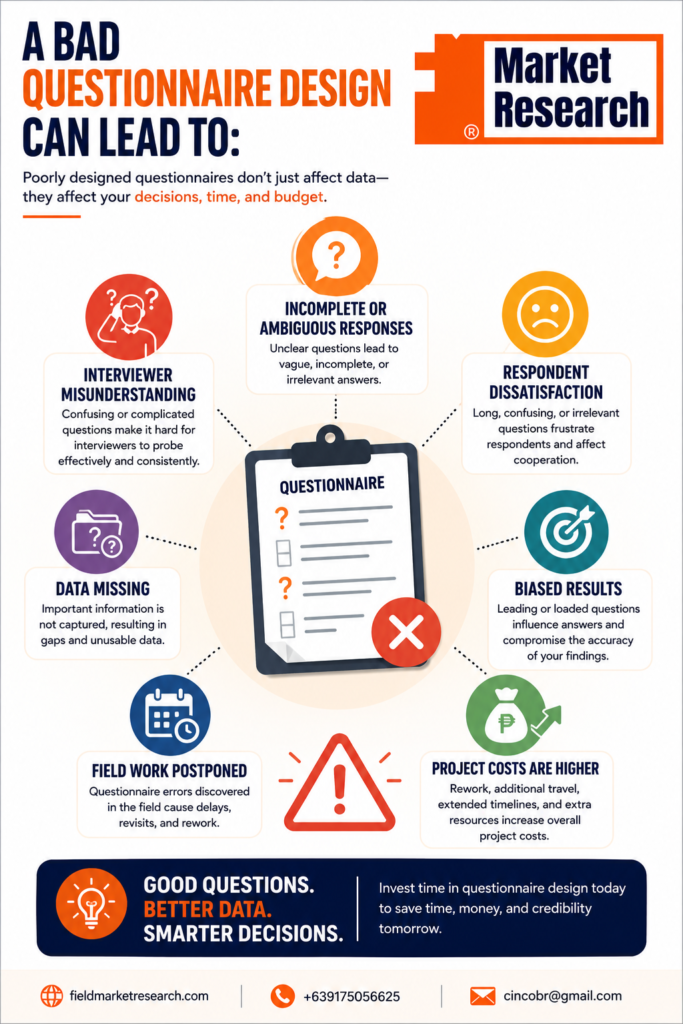
A bad questionnaire design can lead to:
Incomplete or ambiguous responses
Interviewer misunderstanding
Respondent Dissatisfaction
Data missing
Biased results
Field work postponed
Project costs are higher
The effects can be substantially worse for research companies that operate across many provinces and regions. Picture a field team operating in Mindanao, but the project management team in Leyte. If serious inaccuracies are found in the questionnaire after the interviews are completed, the interviewers may need to be retrained, the questionnaire may need to be revised, and some interviews may need to be repeated. In the worst situation teams may have to revisit provinces that have already been visited, which will greatly increase travel expenses and project timelines.
This article talks about how to write a good qualitative interview questionnaire and guide, common problems researchers make and practical measures to evaluate questionnaires before fieldwork begins.
Why Qualitative Questionnaires Are Harder Than You Think
Qualitative interviews differ from quantitative surveys, which tend to rely largely on closed-ended questions, in that they focus on understanding experiences, perspectives, motives and behaviors.
The trick is to come up with questions that can spark real discussions without leading the person answering.
Many new researchers struggle because they:
Ask leading questions
Technical language
Merge several questions into one
Pose questions that can be answered with a “yes” or a “no”
Does not provide a logical flow in the interview
There are times when I feel I could go on forever.
Experts in the research field commonly suggest asking open-ended questions in a neutral, conversational way, allowing participants to freely voice their thoughts.
Common Mistakes with Open-Ended Questions
Mistake #1: Asking Yes/No Questions
Bad Example:
Like the product?
The respondent may simply reply:
“Yes,” I said.
That’s the end of the interview.
Better Example:
“Tell us what you think of the product?”
Or:
“Tell us about your experience with the product?”
These questions allow researchers to dig into underlying motivations and generate detailed responses.
Mistake #2: Leading the Answerer
Bad Example:
What did you most enjoy about our exceptional customer service?
The inquiry presupposes the service was great.
Better Example:
“Could you share your experience with our Customer Service?”
That way, you can give favourable, neutral, or negative feedback.
Mistake #3: Questions with two parts
Bad Example:
“How do you rate the quality of the product and the price?”
The respondent might enjoy the quality but not the price.
Better Example:
1. “What do you think about the product quality?
2. “What’s your feeling about the price of the product?”
Mistake #4: Using Jargon of the Industry
Respondents typically don’t have the technical knowledge researchers do.
Bad Example:
“How would you rate omnichannel integration of the platform?
Better Example:
“How easy or difficult is it for you to use the platform on different devices?”
Creating a Smooth Interview Flow
One of the greatest causes of interview failure is inadequate sequencing of questions.
A qualitative interview questionnaire should feel like a normal conversation, not an interrogation.”
Recommended Structure
1. Warm-Up Questions
Begin with simple enquiries.
Examples:
Tell me a little about yourself.
What is your job like?
How long have you used this product?
These enquiries build rapport and help responders feel comfortable.
2. Questions about experience
Move into real experiences.
Sample:
Tell us about your first experience with the service.
How did it go?
3. Questions about behavior
Look for deeds, not views.
Examples:
What’s your regular routine?
What actions did you take?
4. Questions of Feelings
Feelings and motivation are understood.
E.g. Examples:
How did that encounter make you feel?
What was most discouraging?
5. Things to Think About
Let the participants summarize it.
Examples:
What would you do differently?
Anything else you want to add?
The Hidden Cost of Errors in Questionnaire
Some customers concentrate on interview fees, but underestimate the hazards of questionnaires.
Now, consider this scenario:
Project Location: Mindanao
Research Headquarters: Leyte
Interview Method: CAPI (Computer-Assisted Personal Interview)
Sample Size: 500 Respondents
Field Coverage: 5 Provinces
It all looks ready to go.
On the fourth day, the research team found an important query that they had programmed incorrectly.
Now the team has to:
End data collection
Update questionnaire
Retrain interviewers
Revisit respondents as needed
Deferral of reporting
A minor mistake in the questionnaire might mean thousands of pesos of additional charges and can mean delays of days or even weeks in the execution of the project.
The influence increases with the geographic scope.
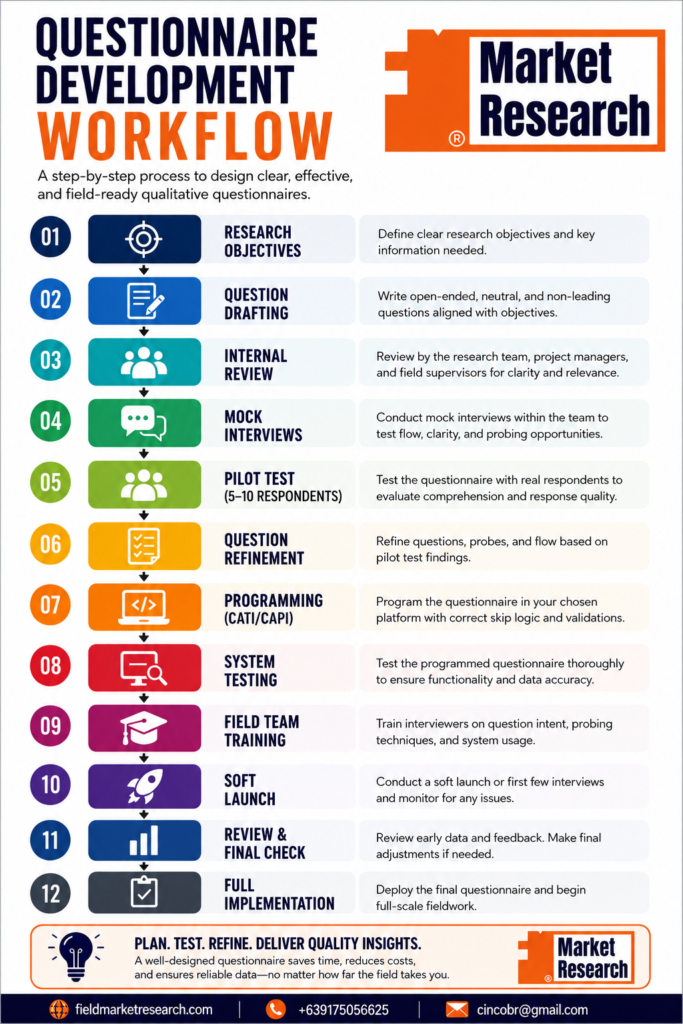
The Golden Rule: Pilot Test All The Things
Never conduct a qualitative study without testing.
Pilot tests are important even for experienced researchers, because real respondents may interpret questions differently than the researcher planned.
Suggested Testing Approach
Stage 1: Internal Review Process
Check the questionnaire with:
Project management
Detectives
Area supervisors
Data Analyst
Step 2: Mock interviews
Mock interviews with your company.
Note:
Questions that puzzle you
Questions that are long
Questions that are repetitive
Lost probes
Stage 3: Soft Launch (Beta)
Interview 5-10 actual respondents
Consider:
Duration of interview
Understanding Questions
Quality of response
Technical difficulties
Stage 4: Final Review:
Refine the questionnaire prior to full rollout.
Best Tools for Questionnaire Development
There are several research platforms that offer resources and training materials to help researchers improve questionnaire design.
Survey Monkey
SurveyMonkey offers tips on qualitative research questions and best practices for questionnaire creation. Researchers can also get educational resources and templates to help them build better surveys.
SurveyToGo is popular for field data gathering and CAPI investigations. It offers training and resources for designing and delivering mobile data collection programs.
SurveyToGo – Researchers should also look at implementation manuals and tutorial videos from their selected platform before starting fieldwork.
Pre-Field Deployment Best Practices
Before deploying interviewers to the field, ensure that:
✓ All the questions are relevant to the research purpose.
✓ Questions are neutral and open-ended.
✓ There are no double-barreled questions.
✓ The interview is conversational in its flow.
✓ Skip patterns are working properly.
✓ Verify the programming logic.
✓ Pilot interviews completed.
✓ Interviewers are trained.
✓ Expected interview duration is checked.
✓ Procedures for emergency field help exist.
A qualitative interview questionnaire is an art and a science. It’s not just about making a list of questions there’s a lot more to it. The questionnaire is the basis of the whole study endeavour and even small mistakes might lead to substantial operational, financial and time problems.
Questionnaires will never be perfect. Even experienced researchers encounter the unexpected when the fieldwork begins. Different ways of understanding questions, local settings and unexpected problems in implementation.
But with careful planning, internal reviews, pilot testing, mock interviews and field validation, researchers can greatly reduce risks and increase the quality of their findings.
The aim is not to produce a perfect questionnaire, but to create a reliable and practical questionnaire that can yield important insights and avoid costly mistakes. For firms that do field market research in various cities, provinces and regions, the effort spent developing questionnaires up front is sometimes the difference between a successful project and an expensive lesson learnt.
At Field Market Research (FMR Technological and Digital Advertising Services), this article reflects the lessons, challenges, and best practices we have gained over 18 years of conducting field market research projects throughout the Philippines.
Bryan R. Cinco
Founder | Field Market Research Specialist
Bryan R. Cinco is the founder of FMR Technological and Digital Advertising Services, specializing in nationwide field market research, survey design, qualitative and quantitative studies, CATI, CAPI, mystery shopping, and data-driven insights for businesses and government organizations.
The global technology industry is entering a period in which location, supply-chain security, skilled manpower, political relationships, infrastructure, and market access are…